News
Christmas is in danger: Santa Claus has a sore back
Published online: 15.12.2025
News
Christmas is in danger: Santa Claus has a sore back
Published online: 15.12.2025
Christmas is in danger: Santa Claus has a sore back
News
Published online: 15.12.2025
News
Published online: 15.12.2025
By Nina Hermansen, AAU Communications & Public Affairs
Photo: AAU Communications & Public Affairs
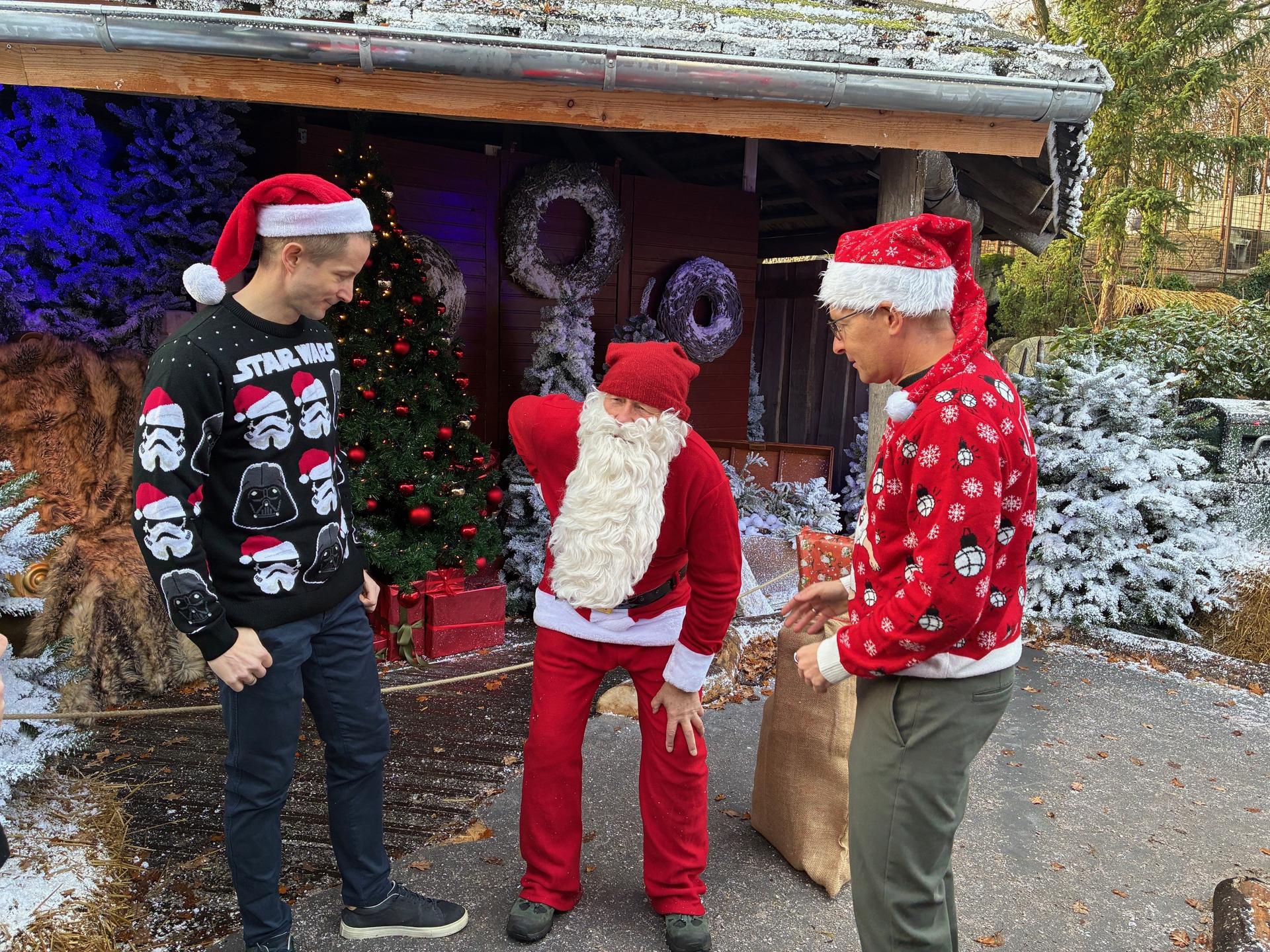
It all began during the annual quality test of the gift bags in the autumn where Santa hurt his back. This kind of thing happens to many of us, but for Santa Claus, it came at a rather inopportune time – in the lead up to the most important holiday of the year.
Since then, the pain has been difficult to overcome. It has become chronic. Neither heating pads, ice baths in Disko Bay nor well-meaning elves' attempts at alternative solutions have helped. For the first time, the question is real:
Will Christmas come this year, or will Santa Claus stay home?

Meet Santa Claus
The rumour about Santa's problem reached Aalborg University as early as November. At the Department of Health Science and Technology, where some of the country's foremost pain researchers are located, there was suddenly a letter where Santa Claus described his situation.
Associate professors Morten Høgh and Steffan W. M. Christensen don’t work with gift making, but they do conduct research on back pain and they immediately recognized Santa's situation. Long-term pain often gives rise to cautiousness and reduced movement - a strategy that, paradoxically, can make the problem worse.
"It's a classic situation. Pain is very real and can be amplified if you are afraid that it is a sign of something dangerous. But the most important thing Santa can do is keep moving as much as pain allows without making it worse. In 97 out of 100 cases, back pain will occur without an underlying injury, and having back pain is basically not dangerous," says Morten Høgh.
Steffan W. M. Christensen agrees. In addition, he explains that pain is like an alarm that is triggered when there is real or potential danger.
"The problem arises when the alarm becomes hypersensitive and reacts to even the slightest movement. Like a smoke alarm that goes off even if you’ve just lit an advent candle. In Santa's case, this is ordinary back pain that has been exacerbated by inappropriate thoughts and actions."
In the aforementioned letter, Santa Claus wrote that he has been lifting heavy gifts for over 100 years, so he assumes that the pain is due to wear and tear. In other words, he is not only worried about missing out on this year's gift race, but that Christmas will have to be completely cancelled as a holiday if he does not find a lasting solution.
But according to the researchers, heavy gift-lifting alone cannot explain back pain. Although people with existing back pain may experience exacerbation of pain with repetitive or heavy lifting, the lifting activity itself may not be the primary cause of the pain. This is shown by a comprehensive research review from 2024.
By the way, there is no "right" way to lift something. It's about persevering and finding the technique you think is best.
"It is completely normal to experience episodes of back pain. But the back is sturdy and made to be used. Also to carry lots of gifts," says Morten Høgh.

In addition to the physical lifting, Santa Claus has also had a home office that has literally been hard to sit in: a classic wooden sleigh without support. So when the pain began, he acquired a more advanced model, which, according to the manufacturer, was supposed to provide relief by ensuring a more appropriate sitting position. But the researchers do not give that much credence.
Steffan W. M. Christensen conducted a randomized crossover study, published in Applied Ergonomics (2023) that examined different sitting positions, although not during reindeer transport, but at a desk. The result was unambiguous: Regardless of sitting position, discomfort occurred when sitting still for too long.
"There is no such thing as an ideal sitting position. But when you sit down for many hours bent over the reins in the cold, it is of course no wonder that the lower back reacts. The solution isn’t just a better sleigh. It's about changing position and moving more," says Steffan W. M. Christensen.
Three Christmas gifts from Aalborg University for your back
Basically, researchers agree that the worst thing Santa Claus can do is cancel Christmas. On the other hand, he needs to take a closer look at his general lifestyle and get to know his pain better. When is the pain the most bothersome? And when is it the least?
"It is completely understandable that Santa Claus is worried, given his great responsibility. In a way, it's actually impressive that he’s only now developed back pain after so many years," says Morten Høgh.
At the same time, the researchers point out that Santa's working conditions – long shifts, darkness, time pressure and very little social contact – increase the body's alertness. His nervous system is guaranteed to be working overtime after many years of Christmas stress and lack of sleep. This makes the experience of pain more salient.
So Steffan W.M. Christensen recommends that he fills his everyday life with activities that bring him joy, and tries to take some of the pressure off his shoulders.
"Most people probably know this. When we do something we think is fun and are with people we care about, we can do more, and we are automatically more active. So Santa Claus needs to move more and get better sleep. And then social relationships are an important piece in how salient the pain is."
A few weeks later, news comes from Greenland. Good news!
Santa Claus goes on daily walks, exercises moderately and has introduced regular movement breaks for the entire workshop. The pain has not completely disappeared, but he’s less worried. He knows what provokes the pain, what subdues it, and what he can afford to do. In other words, he keeps going.
So Christmas will come this year. Thanks to a Santa Claus who, with the help of these smart researchers, has gotten to know his body better and understands the consequences. It is perhaps less magical than expected. On the other hand, it is far more real.
A merry and pain-free Christmas to all!
Limitations
Although this article is based on solid, peer-reviewed research on back pain, the reader should be aware that the object of the study itself – an older, heavily burdened man with a dubious existence – cannot be captured in common research designs.
Conducting valid measurements on a single participant also raises statistical questions in itself. Add to this a number of uncontrollable factors, such as reindeer-based transport and a workload that defies any ergonomic proportionality.
However, the researchers' recommendations stand firm: If such a figure were to exist, their back, like all other people's, would still benefit from movement, variety and a healthy mindset.
References