DEPARTMENT OF HEALTH SCIENCE AND TECHNOLOGY
PhD defense by Mathias Munk-Hansen
Department of Health Science and Technology, Aalborg University
AAU SUND, room 11.00.034
Selma Lagerløfs Vej 249, 9260 Gistrup
29.10.2025 13:00 - 16:00

All are welcome

English

On location
Department of Health Science and Technology, Aalborg University
AAU SUND, room 11.00.034
Selma Lagerløfs Vej 249, 9260 Gistrup
29.10.2025 13:00 - 16:00
English
On location
DEPARTMENT OF HEALTH SCIENCE AND TECHNOLOGY
PhD defense by Mathias Munk-Hansen
Department of Health Science and Technology, Aalborg University
AAU SUND, room 11.00.034
Selma Lagerløfs Vej 249, 9260 Gistrup
29.10.2025 13:00 - 16:00
All are welcome
English
On location
Department of Health Science and Technology, Aalborg University
AAU SUND, room 11.00.034
Selma Lagerløfs Vej 249, 9260 Gistrup
29.10.2025 13:00 - 16:00
English
On location
PROGRAM
13:00: Opening by the Moderator
13:05: PhD lecture by Mathias Munk-Hansen
13:50: Break
14:00: Questions and comments from the Committee
15:30: Questions and comments from the audience at the Moderator’s discretion
16:00 Conclusion of the session by the Moderator
EVALUATION COMMITTEE
The Faculty Council has appointed the following adjudication committee to evaluate the thesis and the associated lecture:
- Associate Professor Daina Sturnieks, University of New South Wales, Australia
- Professor Mirjam Pijnappels Vrije Universiteit Amsterdam, The Netherlands
Chairman: Associate professor Andrew James Thomas Stevenson, HST, Aalborg Universitet
Moderator: Professor Pascal Max Madeleine, HST, Aalborg Universitet
ABSTRACT
Trip-related falls are a major cause of occupational injuries, often leading to long-term disability, productivity loss, and significant economic costs. While safety footwear is essential for protecting workers against hazards such as sharp objects, impacts, and slips, the influence of its design features on trip-related fall risk has received limited scientific attention. This PhD thesis investigates how specific characteristics of safety shoes, such as weight, ankle support, and toe-tip geometry, affect trip-related fall-risk.
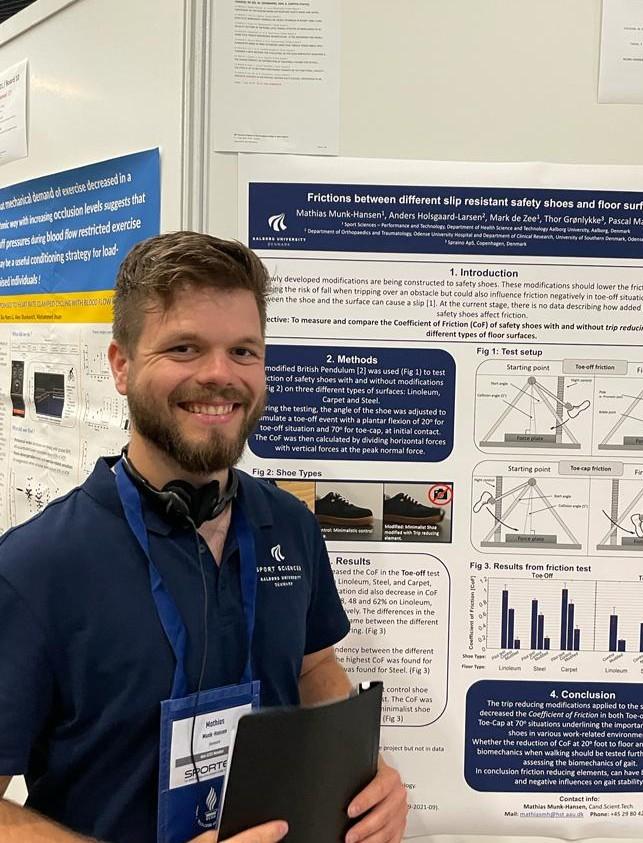
The research comprises four laboratory-based studies. Study I compared the effects of safety shoes and everyday shoes on dynamic balance during treadmill walking with induced trip perturbations. Safety shoes were found to lower the vertical position of the centre of mass and increase swing leg momentum, both of which are associated with a higher risk of falling. Study II focused on ankle support, revealing that safety shoes with ankle support increased reliance on external support (e.g., handrails) after tripping and altered recovery strategies, suggesting reduced gait adaptability. Study III examined gait stability during incline and decline walking with and without ankle support. Shoes with ankle support limited ankle mobility and reduced step length and support durations, indicating a more cautious gait pattern but potentially less stability. Finally, Study IV introduced trip-reducing toe-tip modifications and tested them in a mechanical collision setup. These modifications significantly reduced braking forces during simulated trip events, helping the shoe move forward more easily after impact, which may support safer recovery strategies.
Together, the findings suggest that some protective elements of safety footwear, particularly added weight and ankle support, may unintentionally increase trip-related fall risk by limiting natural gait mechanics and reducing dynamic balance. However, simple design modifications, such as changes to the toe-tip geometry, may reduce these risks.
This thesis contributes new biomechanical and mechanical evidence to guide future footwear design, emphasizing the need to balance structural protection with gait stability. It also indicates the potential for new footwear standards and testing methods that consider trip-related risks alongside traditional safety metrics.